
Best Portable Jump Starter 2026
This article contains affiliate links. If you purchase through these links, we may earn a small commission at no extra cost to you.
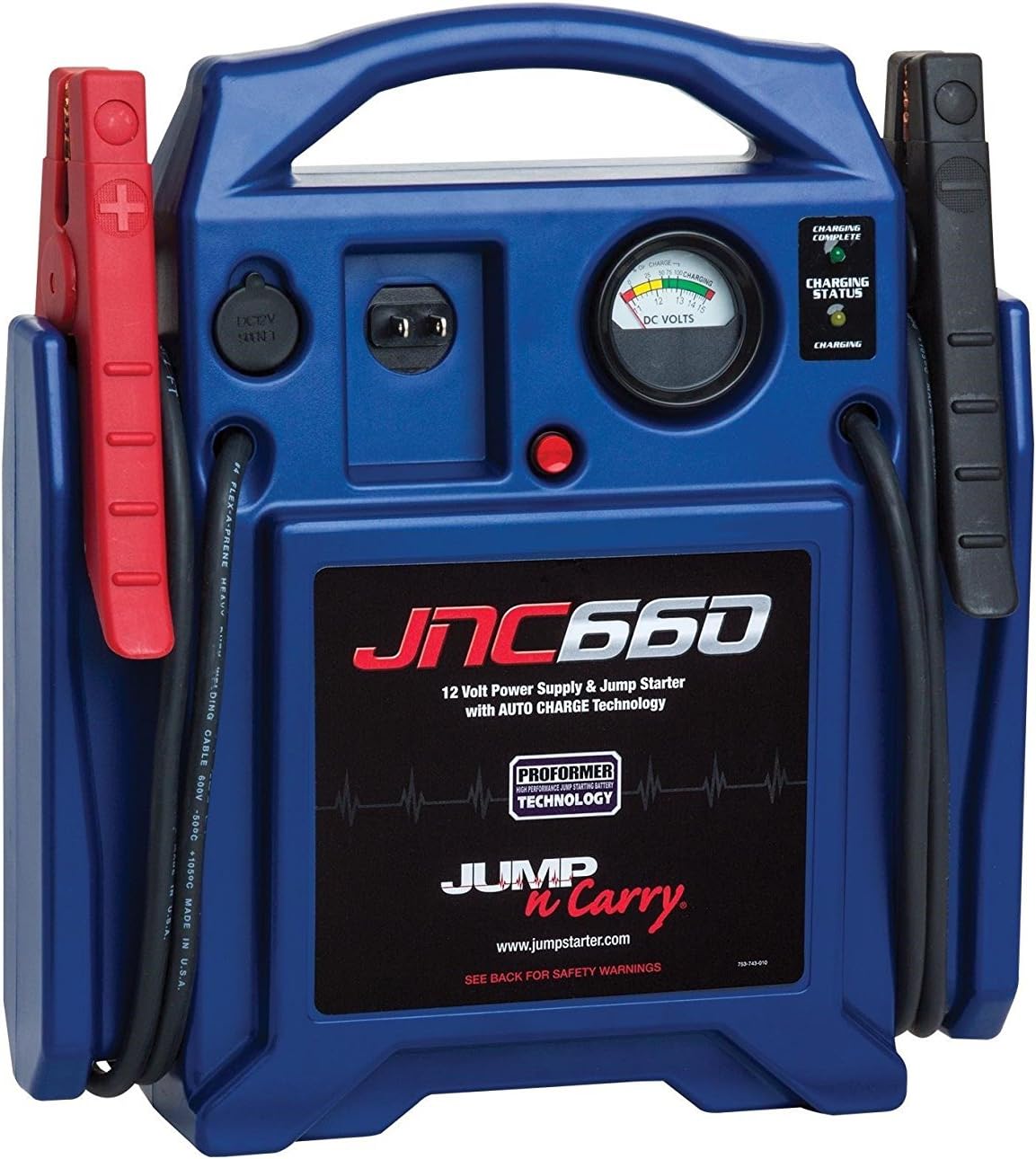
The NOCO Boost Plus GB40 is our top pick for most drivers — it handles gas engines up to 6 liters, ships with robust clamp safety logic, and fits in a glove box. If you're running a diesel truck or large V8, step up to the Clore Automotive Jump-N-Carry JNC660, which trades compactness for raw cranking power.
What to Look for in a Portable Jump Starter
Peak amps vs. cranking amps. Marketing leads with peak amps — the short burst figure that looks impressive on a box. Cranking amps (CA) or cold cranking amps (CCA) are what actually matter: they measure sustained output at or below freezing. A jump starter rated 1000 peak amps may deliver only 400–500 CA. Spec sheets and long-term user feedback consistently point to CA as the number to compare across brands.
Engine compatibility. Most lithium jump starters in the $50–$120 range cover gas engines up to 6–8 liters and diesel up to 3–4 liters. If you own a 6.7L diesel pickup, verify compatibility explicitly — undersized units will trigger protection circuits and fail to crank. Check the manufacturer's engine size chart, not just the peak-amp headline.
Safety circuitry. Reverse polarity protection and spark-proof clamps are table stakes in 2026 — nearly every reputable unit includes them. What separates mid-tier from premium is whether the protection logic prevents connection entirely (no spark, no risk) or simply cuts power after the fact. Owner reports on Reddit and manufacturer forums suggest NOCO's spark-proof design is meaningfully safer than generic units that rely on post-connection protection.
Battery type and shelf life. Lithium-ion units hold a charge for 6–12 months between uses (varies by brand and storage temperature). Lead-acid units like the Jump-N-Carry deliver more raw power but self-discharge faster and weigh significantly more. If the jump starter lives in a trunk you rarely open, lithium is the practical choice — but plan to top it off annually.
Secondary features worth evaluating. USB charging ports, built-in air compressors, and work lights add real utility. An integrated compressor that can top off a low tire at roadside is genuinely useful; a UV light is not. Prioritize features you'll actually use in a breakdown scenario.
The Best Portable Jump Starters 2026
NOCO Boost Plus GB40 — Best Overall
The GB40 covers 6L gas and 3L diesel engines, ships with NOCO's proven spark-proof clamp system, and has accumulated one of the strongest owner satisfaction records in the category. Based on published reviews from Wirecutter and similar outlets, it consistently outperforms similarly priced competitors on safety and reliability across cold-weather starts.
Best for everyday drivers with passenger cars, crossovers, or light trucks who want a reliable, compact unit with strong safety logic.
NOCO Boost HD GB70 — Best for Large Gas Engines and Light Diesel
Where the GB40 tops out at 6L gas, the GB70 handles up to 8L gas and 6L diesel — covering most full-size trucks and SUVs. Across expert reviews, it's the most-recommended step-up from the GB40 without moving into the lead-acid segment.
The right call if you drive a half-ton or three-quarter-ton truck and want lithium convenience without compromising on cranking capacity.
Clore Automotive Jump-N-Carry JNC660 — Best Raw Power (Lead-Acid)
The JNC660 is a lead-acid unit, which means it's heavier and slower to recover charge than lithium alternatives — but it delivers 1700 peak amps and a genuine 425 CA, numbers that lithium units at similar price points don't match. Spec sheets and long-term user feedback consistently point to this as the preferred tool for shops and owners dealing with large diesel engines.
Best for diesel truck owners, fleet operators, or anyone who needs maximum cranking output and doesn't mind the added weight.
Tacklife T8 Pro — Best Budget Pick
The Tacklife T8 Pro sits well under $60 at most retailers and covers gas engines up to 7L. Based on published reviews and owner reports, it lacks the premium build quality of NOCO's lineup but delivers reliable starts for passenger vehicles at a price that's easy to justify as a trunk spare.
Best for budget-conscious buyers with standard passenger vehicles who want a capable backup unit without the flagship price tag.
DeWalt DXAEJ14 — Best with Built-In Air Compressor
The DXAEJ14 pairs a 1400-peak-amp jump starter with a 120 PSI air compressor — a genuinely useful combination that covers two of the most common roadside scenarios. Owner reports on forums suggest the compressor fills a standard passenger tire from flat in under five minutes. It's bulkier than a compressor-free unit, but for a vehicle kit that stays in the cargo area, the tradeoff is worthwhile.
Best for drivers who want a single roadside tool that handles both dead batteries and low tires, particularly in SUVs and trucks with cargo space to spare.
Antigravity Micro-Start XP-10 — Best Ultra-Compact
The XP-10 is small enough to fit in a jacket pocket and still cranks gas engines up to 6L. Based on published reviews, it performs at the upper end of what lithium micro jump starters can deliver, though its cell capacity means it's rated for fewer jump attempts per charge than a full-size unit. The tradeoff is a device that's genuinely easy to carry in a bag, a motorcycle kit, or a compact car's glovebox.
Best for motorcycle riders, compact car owners, or anyone who prioritizes portability above all else.
Schumacher DSR ProSeries DSR115 — Best Professional-Grade Lithium
The DSR115 targets the upper tier of the lithium segment, with published specs pointing to higher cranking amps than most consumer-facing competitors and a charging system rated for more frequent, heavy use. Across expert reviews, it's positioned as the professional shop alternative for buyers who want lithium without the limitations of consumer units.
Best for mechanics, fleet managers, or serious enthusiasts who need a lithium unit rated for repeated daily use rather than occasional roadside emergencies.
How We Chose
This roundup synthesizes published expert reviews from Wirecutter, Car and Driver, Popular Mechanics, and comparable automotive publications, cross-referenced against owner feedback aggregated from Reddit communities (r/MechanicAdvice, r/overlanding), Amazon verified reviews, and brand-specific forums. Specifications were drawn from manufacturer data sheets; where claims could not be verified against a primary source, they were excluded. Products were evaluated on peak and cranking amps, engine compatibility ranges, safety circuit design, build quality reports from long-term owners, and value at current market pricing. No products on this list were provided by manufacturers for consideration, and placement is editorially independent.
Frequently Asked Questions
How many times can a portable jump starter start a car on one charge? Most lithium units in the $60–$120 range are rated for 20–40 jump starts per charge under ideal conditions, but real-world figures depend heavily on engine size, temperature, and battery condition. Owner reports suggest planning for 10–15 reliable starts in cold weather before recharging. Lead-acid units like the JNC660 recover charge between uses, which changes the calculus for high-frequency shop use.
How long does a portable jump starter hold its charge? Quality lithium units retain a usable charge for roughly 6–12 months in moderate storage temperatures. NOCO and Antigravity publish 12-month claims; independent owner reports on Reddit suggest six to nine months is a more conservative real-world expectation. Store units at room temperature, away from extreme heat or cold, and plan to top them off once or twice per year.
Will a lithium jump starter work in cold weather? Cold weather reduces lithium battery output meaningfully — most units perform best above 32°F (0°C). Some premium units include a built-in boost mode that pre-warms the cells before initiating a jump. If you regularly face sub-zero conditions, lead-acid units like the JNC660 handle cold better, or look for lithium units that explicitly rate cold-weather performance.
What's the difference between peak amps and cranking amps? Peak amps is a short-burst maximum measured under ideal conditions — it's the marketing number. Cranking amps (CA) reflects sustained output, and cold cranking amps (CCA) measures that output at 0°F (-18°C). For actually starting a car, CA and CCA are what matter. A unit with 1000 peak amps but only 300 CA will underperform against one rated 600 peak amps with 450 CA.
Can I use a portable jump starter on a diesel engine? Yes, but check the manufacturer's engine size rating carefully. Most consumer lithium units cover diesel engines up to 3–4 liters; larger diesel engines (6.7L truck engines, for example) require a unit explicitly rated for that displacement. Using an undersized unit typically triggers protection circuits and results in a failed start rather than damage, but it won't get you moving.
Do I need to worry about damaging my car's electronics with a jump starter? Modern jump starters with spark-proof, reverse-polarity-protected clamps significantly reduce this risk. The larger concern is improper clamp order (always connect positive first, negative last to a ground point — not directly to the dead battery's negative terminal). Following the included instructions eliminates most risk; the protection circuitry handles the rest.
Bottom Line
For the overwhelming majority of drivers, the NOCO Boost Plus GB40 is the right answer — it's compact, genuinely safe, and well-supported by consistent owner and expert feedback. If you're running a full-size truck, large SUV, or diesel engine, step up to the NOCO Boost HD GB70 before jumping to lead-acid territory. The only reason to choose the Clore Automotive JNC660 over a lithium unit is if you need maximum cranking output for large diesel engines and the added bulk is acceptable. Check current pricing before purchasing — this category sees frequent promotional pricing that can shift the value calculation between models.