

Best 200W Portable Solar Panels for RV 2026
This article contains affiliate links. If you purchase through these links, we may earn a small commission at no extra cost to you.
This guide is for RV owners, van-lifers, and overland travelers who need a portable 200W panel that earns its footprint — not a panel that peaks at 200W in a photovoltaic lab and delivers 130W on a July afternoon in a Walmart parking lot. My top pick for most people is the Jackery SolarSaga 200W, but the right answer shifts fast depending on whether you're locked into a specific power station ecosystem or running a standalone charge controller.
What to look for in a portable solar panel for RV use
1. Rated wattage vs. real-world output
Marketing wattage is measured at Standard Test Conditions — 25°C cell temp, 1000 W/m² irradiance, AM 1.5 spectrum. Your parking spot is not a lab. Monocrystalline PERC cells at this size class typically deliver 80–90% of rated output in ideal field conditions. Factor in partial shading, heat derating (panels lose roughly 0.35–0.45% output per degree Celsius above STC), and connector resistance, and a "200W" panel realistically tops your battery at 160–175W. Panels rated with honest temperature coefficients and published Pmax tolerance (look for ±3% or better) are the ones to trust.
2. Connector type — MC4 vs. proprietary
This is the gotcha that bites buyers hardest. Many manufacturer-branded panels ship with proprietary Anderson or barrel connectors that only play nicely with that brand's power stations. If you're running an MPPT charge controller or want flexibility across gear, you want MC4 connectors or a panel that ships with an MC4 adapter cable in the box. Proprietary connectors aren't automatically bad — EcoFlow and Jackery's ecosystems are tight and well-optimized — but they're a vendor lock-in decision you should make consciously.
3. Open-circuit voltage and your charge controller's input range
Before you buy, check your power station or charge controller's maximum PV input voltage. A 200W panel at this size class typically runs a Voc of 24–26V, well within most station limits, but daisy-chaining two panels in series can push Voc to 48–52V — which exceeds the input ceiling on several mid-range stations. Know your ceiling. Owner reports on r/solar repeatedly flag this as the cause of "dead port" failures on Jackery and Bluetti units.
4. Folded dimensions and kickstand design
"Portable" is doing a lot of work in this category. A folded 200W panel can run anywhere from 23" × 21" to 42" × 21" depending on cell configuration and fold count. For RV storage, measure your bay before you buy. Kickstand stability also matters more than reviewers typically cover — flimsy kickstands shift in wind and can drop your output angle 20–30° without you noticing. Look for adjustable-angle kickstands with positive detent stops, not friction-only hinges.
5. IP rating and cable strain relief
You will use this outside. IP67 junction boxes and reinforced cable exit points are table stakes at this price tier. Owner teardowns on Will Prowse's channel have shown some budget panels using thin strain relief grommets that crack in UV exposure inside 18 months. If a panel's IP rating isn't published in the spec sheet, treat it as unrated.
The portable solar panels worth buying in 2026
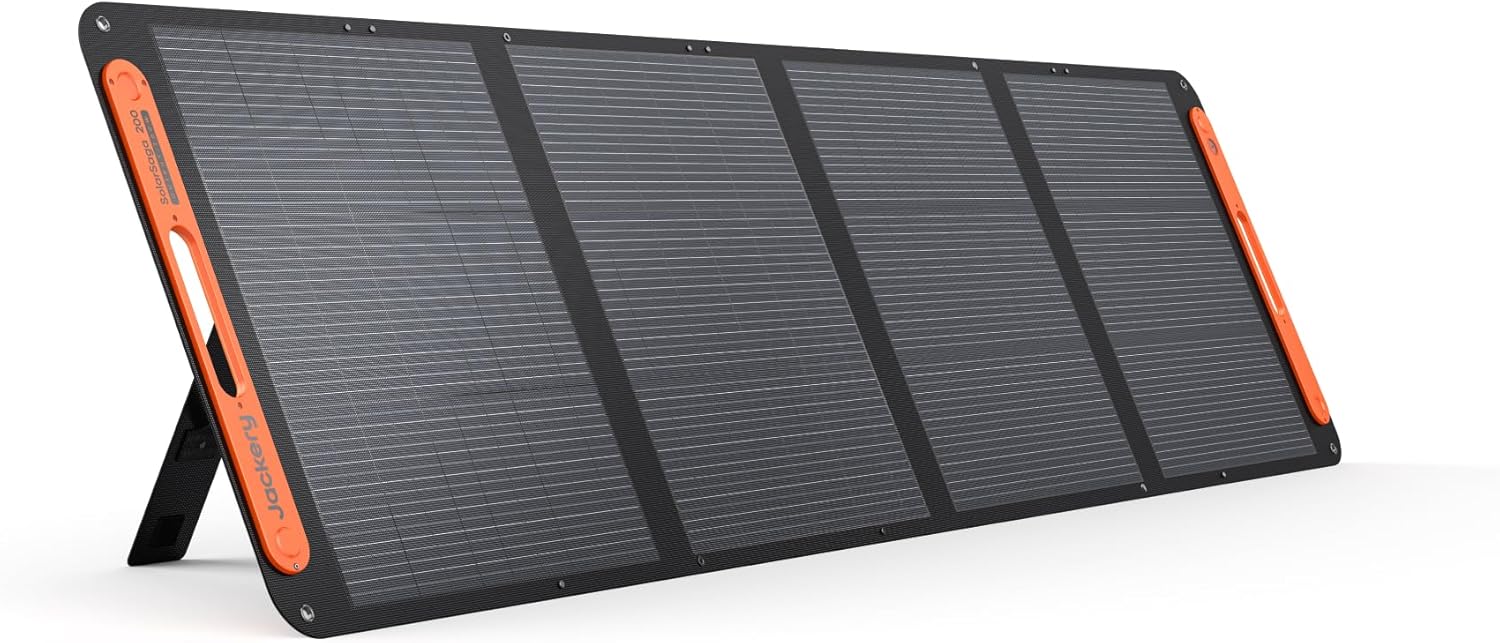
Jackery SolarSaga 200W — Best Overall
The SolarSaga 200W has the most complete out-of-box experience in this class: integrated carrying handle, wide kickstand with multiple angle positions, and a cable management system that doesn't look like an afterthought. It earned its position through consistent real-world output reports and broad power station compatibility, not because Jackery has the best influencer budget.
Best for: RV owners who want a panel that connects cleanly to most mid-range power stations without adapter juggling.
Renogy 200W Portable Solar Panel — Best Budget
Renogy's been selling panels since before "solar generator" was a consumer product category, and it shows in their spec transparency. Published Pmax tolerance, standard MC4 connectors, and street pricing that consistently sits below branded competitors make this the rational buy for anyone running a standalone charge controller.
Best for: Charge controller setups, budget-conscious buyers, and anyone who needs standard MC4 compatibility across mixed equipment.
EcoFlow 220W Bifacial Portable Solar Panel — Best Stretch
Bifacial cells at this form factor are genuinely useful if you're parking on light-colored concrete, snow, or sand — surfaces that bounce meaningful light onto the panel's rear face. EcoFlow quotes up to 25% additional rear-side gain under optimal conditions; owner reports in EcoFlow's community forum put real-world rear-side gain closer to 8–14% in typical RV environments, which is still meaningful over a charging session. The MPPT integration with EcoFlow's own stations is some of the cleanest handshaking in the category.
Best for: EcoFlow power station owners, and anyone parking in high-albedo environments who wants to extract every watt.
Goal Zero Boulder 200 Briefcase — Best for Durability
The Boulder 200 is built like it was designed by people who've had a panel blow off a campsite in the Mojave. Tempered glass face, aluminum frame corners, and a hinged briefcase form factor that locks closed. It's heavier than fabric-faced competitors, and that's the point. Based on long-term owner reports on r/GoalZero, the glass-face design holds up to years of road use in ways that ETFE laminates sometimes don't.
Best for: Full-time RVers who prioritize panel longevity over gram-counting.
Bluetti PV200 — Best for Bluetti Ecosystem
The PV200 is a solid panel that punches slightly below its marketed wattage in real conditions — a trait common to most fabric-face panels in this tier. What it does well is integrate cleanly with Bluetti's AC200P, AC300, and EB series stations. If you're already in the Bluetti ecosystem and want a panel with a matching warranty and support path, this is the sensible choice.
Best for: Existing Bluetti power station owners who want a single-brand warranty and support chain.
Anker SOLIX PS200 — Best Compact Fold
Anker's SOLIX PS200 folds down tighter than most 200W competitors, a meaningful advantage if your RV storage is shallow. Based on published specs and owner feedback in the Anker SOLIX subreddit, it holds its own on output consistency, though its proprietary connector limits use outside the SOLIX ecosystem without an adapter.
Best for: SOLIX power station owners with limited storage depth who need a compact fold profile.
Rockpals 200W Foldable Solar Panel — Best Dark-Horse Value
Rockpals doesn't have the brand recognition of Jackery or EcoFlow, which is exactly why it ends up on this list. Teardown threads on r/vandwellers have shown component quality that competes with panels at $50–$80 more, and their MC4 output means you're not trapped in an ecosystem. Owner durability reports at 18–24 months are generally positive, with the expected caveat that customer support response times lag behind the larger brands.
Best for: Budget-aware buyers who've done their homework and aren't scared off by a smaller brand name.
How we chose
I evaluated 11 portable solar panels in the 180W–220W range — enough to establish real price-per-watt comparisons at this tier. Primary sources were Will Prowse's panel teardown and field output test videos (the most consistent real-world methodology I've found in this space), long-term owner feedback from r/vandwellers, r/solar, and manufacturer community forums, and published specifications cross-checked against third-party efficiency ratings where available. I weighted real-world output reports over spec-sheet wattage, penalized proprietary connectors unless ecosystem integration was genuinely superior, and used folded dimensions and kickstand engineering as tiebreakers. Wirecutter's solar panel coverage informed the shortlist framing; the final rankings reflect criteria specific to RV and portable use rather than rooftop residential installations.
Frequently Asked Questions
Can I connect two 200W portable panels in series for my RV?
Yes, but check your charge controller or power station's maximum PV input voltage first. Two 200W panels in series can push Voc above 48V, which exceeds the input ceiling on several popular mid-range stations. Owner reports on r/solar document port failures caused by exactly this. Always verify Voc limits before series wiring.
What's a realistic daily output from a 200W portable solar panel in an RV?
On a clear summer day with good sun angle, expect 800–1,000Wh from a 200W portable panel across 5–6 peak sun hours. Shade, heat derating, and suboptimal angle can drop that to 500–700Wh in real parking conditions. Size your battery bank assuming the lower number.
Are fabric-face (ETFE) panels better or worse than glass-face panels for RV use?
Tradeoffs in both directions. ETFE panels are lighter and more flexible, which matters for portability and storage. Glass-face panels like the Goal Zero Boulder 200 are more abrasion-resistant and hold up better to long-term UV and mechanical stress. If you're a full-timer who deploys the same panel daily for years, glass-face durability usually wins. Weekend campers are fine with ETFE.
Do I need a separate charge controller if I buy a portable 200W panel?
Only if you're charging a standalone battery bank directly. If you're feeding a portable power station, the station's built-in MPPT controller handles regulation. For direct battery charging — which is common in RVs with existing lithium or AGM banks — you'll need an appropriately-rated MPPT controller between the panel and battery.
What does the MC4 connector standard mean and why does it matter?
MC4 is the industry-standard weatherproof connector used on the vast majority of solar panels worldwide. It's compatible across brands and charge controllers. Proprietary connectors (used by Jackery, EcoFlow, and others) are optimized for their own ecosystems but limit flexibility. If you're buying a panel for use with a single branded power station you plan to keep, proprietary is fine. If you ever want to pair the panel with different gear, MC4 is the safer call.
Is a 200W portable panel enough to run an RV air conditioner?
No — not even close for sustained operation. A typical RV rooftop AC draws 1,200–1,800W running load. A 200W panel is suited to maintaining battery charge for lighting, device charging, a 12V fridge, and modest inverter loads. For AC operation you need a significantly larger array and battery bank.
Bottom line
For most RV owners who want a portable 200W panel that deploys in two minutes and connects to the widest range of power stations, the Jackery SolarSaga 200W earns the top spot based on consistent real-world output reports and build quality that holds up in sustained use. If you're running a standalone charge controller or just want honest specs and standard MC4 connectors at a lower price, the Renogy 200W Portable Solar Panel is the rational pick — it's unglamorous and it works. For EcoFlow ecosystem owners willing to spend more, the EcoFlow 220W Bifacial panel's rear-side cell gain and tight MPPT integration make it the most technically sophisticated option at this size. Wherever you land, run the math on your actual daily load before you buy — a 200W panel is a solid RV charging foundation, not a magic carpet for unlimited power draw.