
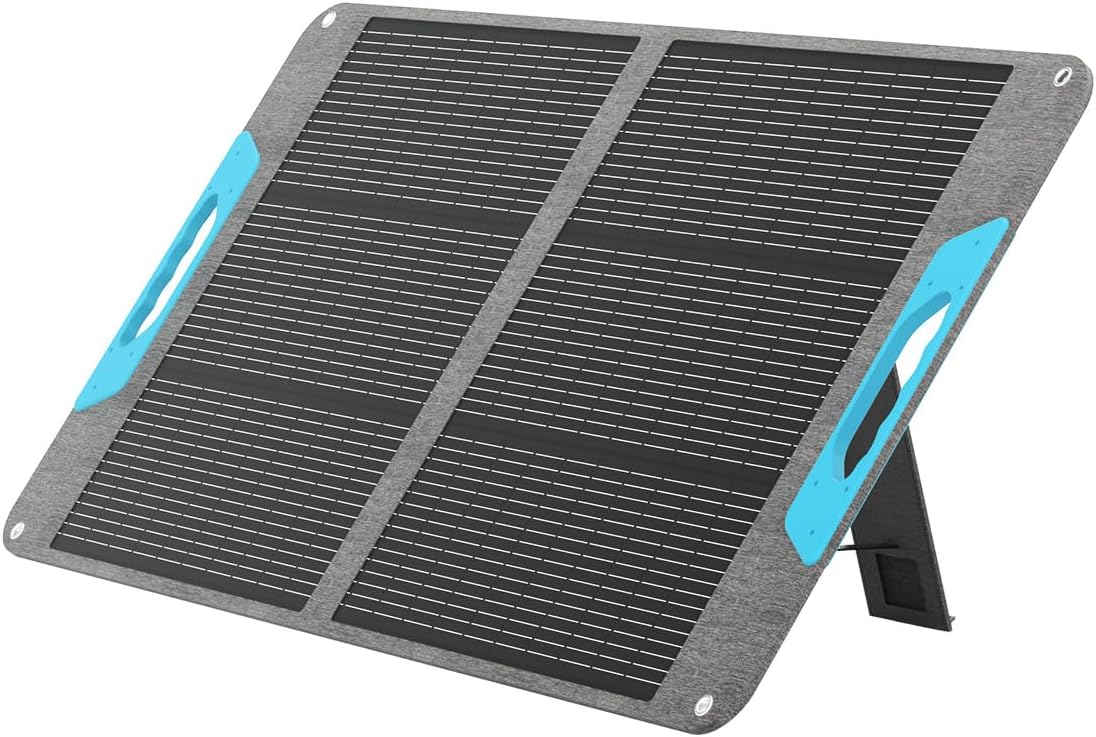
Best Solar Panel for Jackery 1000 (2026)
This article contains affiliate links. If you purchase through these links, we may earn a small commission at no extra cost to you.
This guide is for Explorer 1000 and Explorer 1000 V2 owners who want to maximize solar input without frying their MPPT controller or wasting money on a panel the station can't fully use. The overall pick is the Jackery SolarSaga 100W — not because it's the best panel on paper, but because it's the right panel for this specific machine.
What to look for in a solar panel for the Jackery 1000
1. Voltage ceiling compatibility
The Explorer 1000 (original) accepts a solar input ceiling of 30V at up to 150W. The 1000 V2 bumps that slightly but stays in the same ballpark. This matters because a lot of 200W panels — particularly monocrystalline foldables marketed to "power stations" generically — run open-circuit voltage (Voc) above 30V. Exceed the input ceiling and you risk tripping the BMS or, worse, degrading the MPPT controller over time. Always check Voc, not just rated wattage. Owner posts on r/JackeryPowerStation are littered with confused buyers who paired a Renogy E.Flex 200 and got throttled charging or error codes.
2. Connector type and cable length
The Explorer 1000 uses a DC input port compatible with the Anderson Power Pole / XT60 connector on Jackery's own panels. Third-party panels typically ship with DC5525 or MC4 leads. That's solvable — adapters are cheap — but the cable length matters too. Based on owner feedback, the included Jackery cables are on the short side (roughly 3m), which limits angle optimization. Panels with longer or replaceable leads score better here.
3. Real wattage output vs. rated wattage
Panel efficiency claims are measured at Standard Test Conditions: 1000 W/m² irradiance, 25°C cell temperature. Real-world output on a warm afternoon is typically 75–85% of rated. A "100W" panel reliably delivers 70–85W in practice. Plan charge times accordingly: at 80W effective input into a 1002Wh station, you're looking at roughly 12–14 hours of good sun to fill from flat — not the "10 hours" marketing copy implies. Monocrystalline panels with efficiency ratings above 22% close that gap meaningfully.
4. Portability and kickstand quality
If this panel stays at a fixed campsite or cabin, foldable vs. rigid matters less. If you're car camping or van-dwelling, foldable briefcase-style panels dominate because they store flat and carry as a single unit. Kickstand rigidity is underrated — flimsy stands that won't hold angle in any wind are a recurring complaint in long-term owner reviews. Look for aluminum or reinforced plastic stands with multiple angle stops.
5. Warranty and brand serviceability
A two-year warranty is table stakes. Jackery's own panels carry that. EcoFlow, Bluetti, and Goal Zero all hit two years or better. Be cautious with no-name Amazon panels that offer "3-year" warranties from companies with no US service infrastructure.
The solar panels worth buying in 2026
Jackery SolarSaga 100W — Best Overall
The first-party option exists for a reason: zero compatibility risk. The SolarSaga 100W is spec'd to match the Explorer 1000's input window exactly, ships with the correct connector, and Jackery's own charge-time estimates are based on this pairing. It's not the highest-efficiency panel on this list, but it's the one you can plug in without reading a voltage spec sheet first.
Best for: Jackery 1000 owners who want a guaranteed plug-and-play experience and don't want to source adapters or verify third-party compatibility.
Bluetti PV120 Solar Panel — Best Value
At roughly 120W with monocrystalline cells rated above 23% efficiency, the PV120 delivers more real-world wattage than the SolarSaga 100W at a price that's typically lower. The catch: it ships with a DC7909 connector, so you'll need a DC7909-to-XT60 adapter (available for under $10, widely stocked). Owner reports on r/SolarDIY confirm the Voc sits comfortably within the Explorer 1000's input range.
Best for: Budget-conscious buyers comfortable sourcing a single adapter and willing to do a quick spec check before plugging in.
EcoFlow 160W Portable Solar Panel — Best for Fast Charging
EcoFlow's 160W foldable is the stretch pick here. It pushes the Explorer 1000's solar input closer to its ceiling than any 100W-class panel can, which meaningfully shortens charge times when cloud cover or limited daylight hours are the constraint. Published reviews at OutdoorGearLab noted the build quality — particularly the aluminum kickstand — as above average in this wattage class.
Best for: Owners with limited sun windows (Pacific Northwest, shoulder-season camping) who want to extract maximum charge per available hour.
Goal Zero Nomad 100 Solar Panel — Best Build Quality
Goal Zero's Nomad 100 is heavier and pricier than comparable wattage competitors, and Goal Zero's marketing has leaned luxury-camp for years. But the build quality is legitimate — owner teardowns on YouTube (notably by the channel DIY Solar Power with Will Prowse) have consistently shown robust lamination and waterproofing relative to the price tier. Pairs with the Explorer 1000 via a supplied 8mm adapter; Voc is within spec.
Best for: Buyers who prioritize durability over value-per-watt and are willing to pay the Goal Zero premium for panel longevity.
Anker 625 Solar Panel (100W) — Best Compact Footprint
The Anker 625 folds smaller than most 100W panels in this category, which matters if storage space is tight. Efficiency ratings are competitive, and Anker's build quality on the 625 series has drawn favorable long-term owner feedback. Connector compatibility requires the same DC adapter approach as the Bluetti — plan for a $5–8 adapter.
Best for: Campers and van-lifers where packed size is a genuine constraint and the slight wattage tradeoff versus larger panels is acceptable.
Renogy E.Flex 100W Portable Solar Panel — Runner-Up Budget Pick
Renogy has the brand recognition and the price, and the E.Flex 100W lands at the lower end of this tier. Worth noting: a vocal subset of Explorer 1000 owners on r/JackeryPowerStation have reported that Renogy's 200W variant exceeds the 1000's Voc ceiling — but the 100W version spec checks out. If the Bluetti PV120 is out of stock, this is the next budget move.
Best for: Buyers who want a recognized brand at a budget price and don't need more than 100W input.
How we chose
The shortlist was built from nine panels that appear consistently in owner discussions on r/JackeryPowerStation, r/SolarDIY, and the Jackery Community Forum, cross-referenced against published expert reviews from OutdoorGearLab and Wirecutter's portable solar coverage. Dominant criteria, in order: (1) open-circuit voltage compatibility with the Explorer 1000's documented MPPT input ceiling, (2) real-world watt output as reported by owners against rated specs, (3) connector compatibility and adapter availability, (4) folded portability dimensions and kickstand durability, (5) warranty terms and brand serviceability in North America. Panels with unverified Voc specs or no established owner feedback base were excluded regardless of price.
Frequently Asked Questions
Can I use two 100W solar panels with the Jackery Explorer 1000? Yes, in parallel — not in series. Parallel keeps voltage constant while doubling current, which stays within the Explorer 1000's input spec. Wiring two panels in series would push voltage above the 30V ceiling and risk controller damage. You'll need a parallel connector (Y-splitter, MC4 or DC type depending on your panels), and total wattage still can't exceed the station's 150W solar input limit.
Why does my Jackery 1000 charge slower than the rated time even with a matched panel? Real-world panel output runs 75–85% of rated wattage due to temperature derating, non-optimal sun angle, and haze. A 100W panel realistically delivers 70–85W at good conditions. Factor that into your estimate: 1002Wh ÷ 80W effective = roughly 12.5 hours of solid sun. Jackery's "10-hour" marketing figure assumes close to rated output throughout — not a field-realistic number.
Do I need an adapter to use third-party panels with the Jackery Explorer 1000? Almost certainly yes. Jackery's DC input uses a proprietary connector (XT60 variant on the Explorer 1000). Most third-party panels ship with DC5525, DC7909, or MC4 leads. The adapters are cheap ($5–12) and widely available, but verify the connector type before ordering and confirm the adapter is rated for your panel's wattage.
Is a higher-wattage panel always better for the Explorer 1000? Not past the station's input ceiling. The Explorer 1000 maxes out at 150W solar input. A 200W panel won't charge it faster than a 150W panel — the excess wattage is simply rejected. Where higher wattage helps is output headroom in suboptimal conditions: a 160W panel hitting 80% efficiency still delivers more than a 100W panel at the same efficiency ratio.
Will third-party panels void the Jackery Explorer 1000 warranty? Jackery's warranty language focuses on damage caused by exceeding rated input specifications. Using a third-party panel that stays within Voc and wattage limits is generally not a warranty-voiding act in practice — but Jackery's support has discretion. Using a panel that exceeds the 30V Voc ceiling and causes MPPT damage is a different story. Stick to spec-matched panels and you're covered.
Bottom line
If you own a Jackery Explorer 1000 or 1000 V2 and want the no-stress solar setup, the Jackery SolarSaga 100W is the pick — compatible out of the box, correct cable included, no adapter hunting. For buyers who'll spend five minutes sourcing a DC adapter and checking a spec sheet, the Bluetti PV120 delivers more watts per dollar and is a genuine upgrade in real-world charge performance. If your camping window is short on daylight hours and you want the fastest reasonable charge time without going full rigid panel, the EcoFlow 160W is worth the extra spend — it pushes the Explorer 1000 closer to its input ceiling than any 100W-class panel can. All three picks stay within the Explorer 1000's voltage limits; that's the non-negotiable filter that knocked four other candidates off this list.